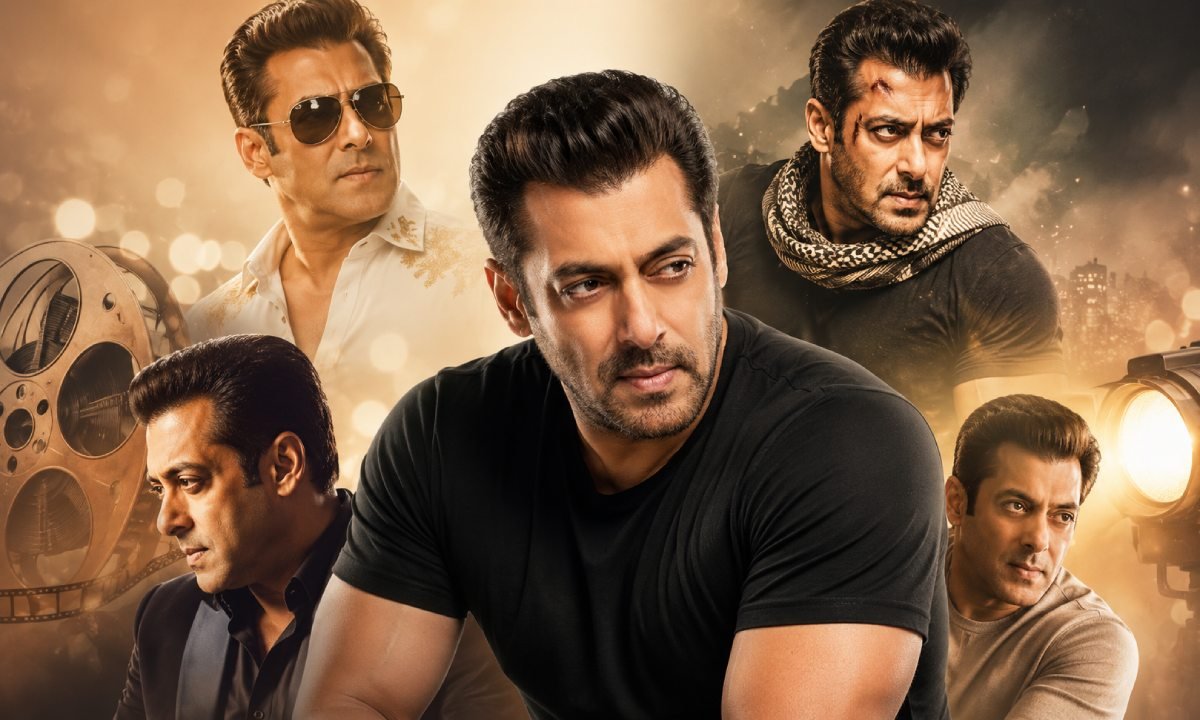
Salman Khan is one of the most recognizable and influential stars in Indian cinema. Known for his charismatic screen presence, distinctive style, action performances, emotional roles, and strong connection with audiences, he has built a career spanning several decades. Beyond acting, he has also worked as a film producer and television host and has been associated with charitable initiatives through his public platform.
Born on December 27, 1965, Salman Khan has remained a major figure in Hindi entertainment since the late 1980s. His journey includes early struggles, a breakthrough as a romantic hero, periods of career uncertainty, a remarkable comeback, and the development of a mass-market action-star image that became closely associated with Bollywood.
Early Life and Family Background
Salman Khan was born on December 27, 1965, in Indore, Madhya Pradesh, India. He comes from a prominent film family. His father, Salim Khan, is a celebrated screenwriter who was part of the famous Salim-Javed writing partnership and contributed to landmark Hindi films. Growing up around the film industry gave Salman an early exposure to cinema, storytelling, and entertainment.
Salman has brothers Arbaaz Khan and Sohail Khan and sisters including Alvira Khan Agnihotri. Several members of his family have been involved in the Indian entertainment industry. However, despite his family background, Salman had to establish his own identity as an actor and develop a distinct connection with audiences.
His family background eventually became an important part of his public identity, but his popularity was primarily built through his performances, screen personality, and relationship with his fans.
Beginning of His Acting Career
Salman Khan began his film career with a supporting role in Biwi Ho To Aisi in 1988. Although the role was not a major leading performance, it gave him an opportunity to enter the Hindi film industry professionally. His career changed dramatically the following year when he appeared as the lead in Sooraj Barjatya’s romantic film Maine Pyar Kiya.
Maine Pyar Kiya became a major success and transformed Salman into a popular young star. His portrayal of Prem introduced audiences to the image of Salman as a charming, romantic, youthful hero.
The film also earned him the Filmfare Award for Best Male Debut, establishing an important early milestone in his career.
Rise to Stardom in the 1990s
The 1990s were an important period in Salman Khan’s development as a leading Bollywood actor. He appeared in romantic films, family dramas, comedies, and action-oriented projects, gradually demonstrating his ability to work across different genres.
Films such as Saajan, Hum Aapke Hain Koun..!, Karan Arjun, Judwaa, Pyaar Kiya To Darna Kya, Hum Dil De Chuke Sanam, Biwi No. 1, and Hum Saath-Saath Hain helped establish him as one of the industry’s most commercially successful stars.
Hum Aapke Hain Koun..! was particularly important because of its enormous popularity and family-oriented storytelling. Salman also demonstrated his versatility by taking on different kinds of roles throughout the decade.
His performance in Kuch Kuch Hota Hai as Aman also earned him the Filmfare Award for Best Supporting Actor, showing that his appeal was not limited to conventional leading roles.
Career Challenges in the 2000s
Like many long-running actors, Salman Khan experienced periods when his films did not perform as strongly as audiences had come to expect. The early and middle part of the 2000s included both successful and less successful projects.
However, this period also produced performances that became important to his reputation. His role in Tere Naam received considerable attention, while films such as Mujhse Shaadi Karogi, No Entry, and Partner demonstrated that he could continue attracting audiences in comedy and commercial entertainment.
This phase of his career ultimately became a period of transition. Salman was moving away from being known primarily as a romantic hero and toward the larger-than-life action and entertainment persona that would define much of his later career.
The Comeback With Wanted
One of the major turning points in Salman Khan’s career came with Wanted in 2009. The film helped revive his commercial image and presented him in a powerful action-oriented role.
The success of Wanted was followed by a remarkable run of commercially successful films. Salman increasingly became associated with action, humor, memorable dialogue, physical performances, and a larger-than-life screen personality.
His career resurgence demonstrated that a star can reinvent his public image even after experiencing periods of uncertainty.
The Dabangg Era
The release of Dabangg in 2010 marked another defining moment in Salman Khan’s career. His portrayal of police officer Chulbul Pandey became one of his most recognizable characters.
The film combined action, comedy, music, romance, and a highly distinctive protagonist. Chulbul Pandey’s mannerisms, dialogue delivery, and attitude became widely recognizable among Indian audiences.
The success of Dabangg established a new version of Salman Khan’s screen persona: confident, humorous, physically powerful, and capable of delivering action while maintaining a strong entertainment value.
The franchise later continued with Dabangg 2 and Dabangg 3. Salman Khan Films’ official filmography includes Dabangg 3 among its productions.
Salman Khan as an Action Superstar
During the 2010s, Salman Khan became particularly associated with commercially successful action films. Projects including Bodyguard, Ek Tha Tiger, Kick, and Tiger Zinda Hai strengthened his image as a major action star.
The Tiger franchise became especially important to his career. His portrayal of Tiger combined espionage-style action with emotional storytelling and romance, creating a character that audiences could follow across multiple films.
At the same time, Salman continued working in different genres. Bajrangi Bhaijaan offered a more emotional and humanitarian story, while Sultan combined sports, drama, romance, and personal transformation. These films demonstrated that his commercial appeal could coexist with more emotionally focused performances.
Bajrangi Bhaijaan and Sultan
Bajrangi Bhaijaan, released in 2015, became one of Salman Khan’s most widely appreciated films. The story centered on a kind-hearted man who attempts to help a lost Pakistani girl return to her family.
The film combined humor, emotion, friendship, family values, and a message of humanity. Salman played the central character with a comparatively restrained style, allowing the emotional story to remain at the heart of the film.
His 2016 sports drama Sultan was another significant project. Salman portrayed a wrestler who experiences professional success, personal setbacks, and a difficult journey of rebuilding himself. The role required substantial physical preparation and reinforced his ability to headline large-scale commercial dramas.
Salman Khan as a Television Host
Salman Khan’s influence extends beyond cinema. He has also become strongly associated with Indian television, particularly through his work as the host of Bigg Boss.
He hosted multiple seasons of the reality television franchise and developed a distinctive hosting style involving humor, direct interaction, criticism, and conversations with contestants.
Television helped Salman remain closely connected with audiences even between film releases. His presence on a weekly television program created another major platform through which viewers could engage with his personality.
His television career also included hosting 10 Ka Dum, a game show that further expanded his presence outside films.
Salman Khan as a Producer
Salman Khan has also established himself as a film producer. He founded Salman Khan Films in 2011, creating a production platform through which he could support and develop film projects. The production house is based in Mumbai and has been associated with projects including Bajrangi Bhaijaan, Hero, Bharat, Dabangg 3, Antim, and Sikandar.
The production company has also provided opportunities for new talent and worked with established filmmakers on commercial and story-driven projects.
This transition from actor to actor-producer represents another important part of Salman’s career. It allowed him to participate in filmmaking beyond his own performances.
Salman Khan and Philanthropy
Salman Khan has also become known for his philanthropic activities. His charitable identity is strongly associated with Being Human, a foundation and lifestyle brand connected with his public image.
His charitable work has contributed to his reputation as a celebrity who uses his popularity to support social causes. Over the years, his philanthropic activities have been an important part of his public profile alongside his entertainment career.
For many fans, this aspect of his personality has become an additional reason for their connection with him.
Awards and Recognition
Salman Khan has received numerous awards and nominations throughout his career. His early Filmfare recognition came with Maine Pyar Kiya, while his supporting performance in Kuch Kuch Hota Hai also earned a Filmfare Award.
His production work has also received national recognition. His production of Chillar Party was associated with a National Film Award for Best Children’s Film.
Over the years, he has received recognition from several major Indian entertainment awards and international platforms. His long-standing popularity has also resulted in numerous fan-voted and popular-choice honors.
Salman Khan’s Most Popular Films
Salman Khan’s filmography includes a large number of commercially successful movies. Among the titles frequently associated with his career are Maine Pyar Kiya, Hum Aapke Hain Koun..!, Karan Arjun, Judwaa, Hum Dil De Chuke Sanam, Tere Naam, Wanted, Dabangg, Ek Tha Tiger, Bajrangi Bhaijaan, Sultan, Tiger Zinda Hai, Bharat, and Tiger 3.
His official production house also lists projects including Kisi Ka Bhai Kisi Ki Jaan, Antim, Radhe, Farrey, and Sikandar.
Salman Khan’s Unique Connection With Fans
One of the most remarkable aspects of Salman Khan’s career is his relationship with his fan base. His fans often refer to him affectionately as “Bhaijaan,” reflecting the personal connection many viewers feel toward him.
His popularity has remained strong because his screen identity is easy to recognize. Whether he is playing a romantic hero, police officer, spy, wrestler, soldier, or comedic character, audiences often associate his performances with his distinctive personality.
His annual film releases have also become major entertainment events, with audiences closely following announcements, trailers, songs, and theatrical releases.
Style and Influence on Popular Culture
Salman Khan has influenced Bollywood fashion, fitness culture, action choreography, dialogue delivery, and celebrity branding. His physical appearance and fitness have been particularly influential among younger audiences.
His style has often favored simple clothing, fitted casual wear, bracelets, sunglasses, and a recognizable rugged appearance. His popularity has helped turn certain fashion and fitness trends into mainstream phenomena.
His signature mannerisms have also been frequently referenced and imitated in popular culture.
Recent Work and Future Projects
Salman Khan continues to remain active in Hindi cinema. His filmography includes Sikandar, released in 2025, while Salman Khan Films’ official website lists Maatrubhumi: May War Rest in Peace among its upcoming projects and has also reported a future Eid 2027 project with Nayanthara directed by Vamshi Paidipally.
His continued involvement in large-scale projects demonstrates that his position in mainstream Indian entertainment remains significant even after decades in the industry.
The Legacy of Salman Khan
Salman Khan’s career is a story of transformation. He began as a young romantic hero, became a major family entertainer, experienced difficult professional periods, and later reinvented himself as one of India’s biggest action and commercial stars.
His contribution to Hindi cinema extends beyond the number of films he has appeared in. He has influenced popular culture, television, celebrity branding, action entertainment, and film production.
What makes his journey particularly notable is his ability to remain relevant across different generations. Audiences who grew up watching Maine Pyar Kiya have continued following his later films, while younger audiences have discovered him through movies such as Dabangg, Bajrangi Bhaijaan, Sultan, and the Tiger franchise.
Frequently Asked Questions About Salman Khan
When was Salman Khan born?
Salman Khan was born on December 27, 1965, in Indore, Madhya Pradesh, India.
What was Salman Khan’s first movie?
Salman Khan made his acting debut with a supporting role in Biwi Ho To Aisi in 1988. His breakthrough as a leading actor came with Maine Pyar Kiya in 1989.
Which movie made Salman Khan famous?
Maine Pyar Kiya was the major breakthrough that established Salman Khan as a leading Hindi-film star. The film became a major commercial success and earned him the Filmfare Award for Best Male Debut.
What is Salman Khan best known for?
Salman Khan is known for his work as a Hindi-film actor and producer, particularly for romantic films, action entertainers, comedies, family dramas, and television hosting. He is also widely known for his role as the host of Bigg Boss.
What are some of Salman Khan’s most popular movies?
Some widely recognized films from his career include Maine Pyar Kiya, Hum Aapke Hain Koun..!, Karan Arjun, Hum Dil De Chuke Sanam, Wanted, Dabangg, Ek Tha Tiger, Bajrangi Bhaijaan, Sultan, and Tiger Zinda Hai.
Is Salman Khan also a producer?
Yes. Salman Khan founded Salman Khan Films in 2011 and has been involved in producing several films.
Has Salman Khan worked on television?
Yes. He has hosted television programs including 10 Ka Dum and multiple seasons of Bigg Boss.
What is Salman Khan’s production company?
His production company is Salman Khan Films, commonly abbreviated as SKF. It was founded in 2011 and is based in Mumbai.
Conclusion
Salman Khan’s biography is more than the story of a Bollywood actor. It is the story of a performer who successfully evolved through changing eras of Indian cinema. From his breakthrough in Maine Pyar Kiya to the action-driven success of Dabangg, Ek Tha Tiger, and the Tiger franchise, and from emotional films such as Bajrangi Bhaijaan to his long-running television career, Salman has built a distinctive place in Indian popular culture.
His journey includes extraordinary success, professional challenges, reinvention, production, television, philanthropy, and an unusually strong relationship with audiences. After decades in the entertainment industry, Salman Khan continues to remain one of the most recognizable names in Hindi cinema.