
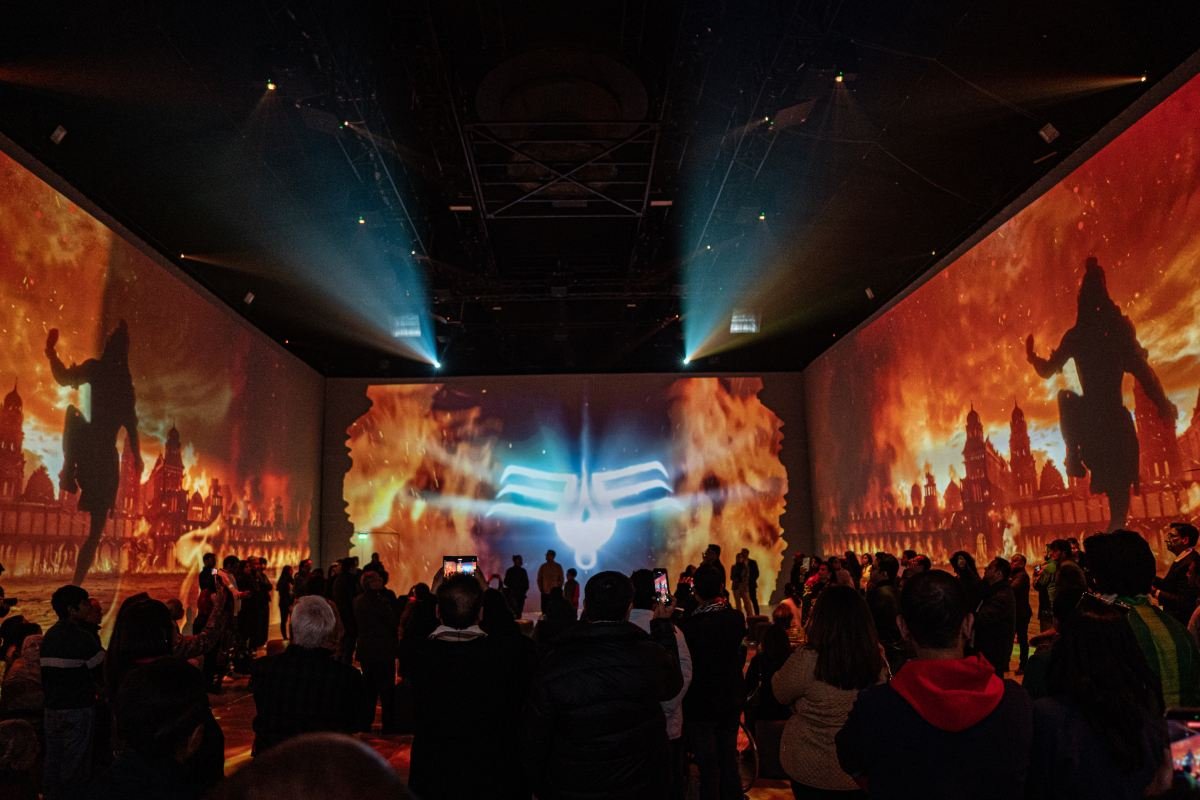
Indian mythology has been passed from one generation to another through scriptures, oral traditions, television, cinema, theatre, art, music, and storytelling. But what happens when one of the most powerful mythological narratives is presented through 360-degree visuals, spatial sound, lasers, virtual reality, lighting, and immersive environments?
That is the idea behind Shiva Immersive, a large-format experiential production that brings stories associated with Lord Shiva into a technology-driven environment. Rather than asking audiences to simply sit and watch a conventional performance, the experience is designed to surround visitors with visuals, sound, movement, atmosphere, and storytelling.
Created and produced by E-Factor Experiences Limited, Shiva Immersive has been presented as India’s first large-format immersive storytelling experience of its kind, combining Indian mythology with contemporary experiential technology.
What Is Shiva Immersive?
Shiva Immersive is an immersive storytelling experience inspired by the mythology and philosophy surrounding Lord Shiva.
Instead of presenting the story through a conventional theatre stage or a traditional film screen, the production uses a large-scale environment where visuals can appear around the audience.
According to the official Shiva Immersive website, the experience combines 360-degree projection, spatial sound, lasers, lighting, haze, virtual reality, and a reflection zone to create a multisensory journey.
The objective is not simply to show mythology but to make audiences feel surrounded by it.
This approach changes the relationship between the viewer and the story. The audience is no longer looking at a distant screen; the environment itself becomes part of the narrative.
Why Shiva Was Chosen for an Immersive Experience
Lord Shiva occupies a unique position in Indian mythology and philosophy.
Shiva represents many seemingly opposite ideas at once: creation and destruction, stillness and movement, meditation and cosmic energy, asceticism and family life.
These themes provide enormous creative possibilities for visual storytelling.
A conventional narrative can explain these ideas through dialogue and scenes. An immersive experience can attempt to communicate them through scale, sound, movement, darkness, light, atmosphere, music, and visual symbolism.
That makes Shiva particularly suitable for an experience that wants to combine mythology with technology.
Shiva Immersive Is More Than a Traditional Show
One of the most important aspects of Shiva Immersive is that it does not position itself as a conventional play or film.
The official website describes it as an immersive journey in which the story surrounds the audience through visual and sensory elements.
This distinction is important.
In a traditional theatre performance, the audience generally faces the stage.
In a cinema, the audience faces the screen.
In an immersive environment, the audience can become physically surrounded by the storytelling environment.
The ceiling, walls, floor, soundscape, lighting, and atmosphere can all become part of the experience.
The 360-Degree Immersive Zone
The central immersive zone is designed around a continuous visual narrative.
The official description explains that the approximately 25-minute immersive segment uses 360-degree projection, spatial sound, lasers, lighting, and haze to create a surrounding environment.
This can create a very different sensory experience from watching mythology on television or a conventional screen.
Images can appear across a large visual field while sound moves through the space.
The result is intended to create a sense of scale and presence, allowing audiences to feel as though they are inside the world being presented.
The Role of Projection Technology
Projection is one of the core technologies behind the experience.
Instead of projecting content onto a single rectangular screen, large-format projection can cover architectural surfaces and create an environment where visuals appear to extend beyond the traditional boundaries of cinema.
This technology allows creators to transform an ordinary physical space into something completely different.
Mountains, cosmic landscapes, mythological environments, symbolic imagery, movement, light, and other visual elements can be created digitally and synchronized with sound.
Spatial Sound Makes the Experience More Immersive
Visuals are only one part of an immersive experience.
Sound can strongly influence how audiences perceive space and emotion.
Shiva Immersive uses spatial sound and an original musical score to complement the visual narrative. The combination of sound, music, environmental effects, and imagery is intended to create a more complete sensory experience.
Instead of simply hearing background music from speakers, audiences can experience sound as part of the surrounding environment.
This can increase the emotional intensity of particular moments.
The Virtual Reality Journey to Kailash
One of the most distinctive components of Shiva Immersive is its VR experience.
After the main immersive segment, visitors can enter a virtual reality journey associated with Mount Kailash.
The official website describes this as an exploration of Kailash, using VR to create an encounter with a location that is deeply significant in Shiva traditions and difficult for many people to experience physically.
Virtual reality allows the experience to shift from a large shared environment to a more personal perspective.
The technology creates a simulated environment that can give visitors the feeling of entering another landscape.
The Reflection Zone
Shiva Immersive also includes a reflection component.
Following the visual spectacle and VR journey, visitors enter a calmer environment designed around stillness and contemplation.
The official description presents this area as a space where the experience becomes less about external spectacle and more about internal reflection.
This is an interesting part of the overall design because Shiva is often associated with meditation and stillness.
The experience therefore moves through different emotional states rather than maintaining the same level of intensity throughout.
The Journey From Spectacle to Reflection
A well-designed immersive experience needs pacing.
If every moment is loud, bright, and visually intense, audiences can eventually become overwhelmed.
Shiva Immersive appears to use different stages to create contrast.
The immersive zone provides scale and spectacle. The VR journey creates personal exploration. The reflection zone provides a quieter ending.
Together, these stages create a journey rather than simply a sequence of visual effects.
Bringing Indian Mythology to Younger Audiences
One of the biggest opportunities presented by Shiva Immersive is its ability to introduce mythology to younger generations through a medium they already understand.
Younger audiences are familiar with gaming, virtual reality, cinema, digital animation, social media, and interactive entertainment.
Presenting ancient narratives through contemporary technology can create a bridge between traditional cultural stories and modern forms of entertainment.
This does not necessarily replace traditional storytelling.
Instead, it can create another way of approaching familiar stories.
Shiva Immersive and Cultural Technology
The production is an example of what can broadly be described as cultural technology.
Cultural technology involves using modern creative and technological tools to present cultural stories, heritage, traditions, and historical narratives.
India has an enormous collection of stories, art forms, architectural traditions, festivals, music, mythology, and cultural practices.
Projects like Shiva Immersive demonstrate how these subjects can potentially be presented through formats that appeal to contemporary audiences.
The Importance of Experience Design
Shiva Immersive is also an example of experience design.
Experience design is not simply about creating beautiful visuals. It considers how people move through a journey and what they should feel at different stages.
The environment, sound, technology, narrative, timing, lighting, seating, transitions, and final moments all contribute to the overall experience.
The World Experience Organization has described Shiva Immersive as a 20,000-square-foot multisensory environment combining projection architecture, spatial sound, atmospheric effects, and VR.
This places the project within the wider global conversation around immersive experiences and the experience economy.
Who Created Shiva Immersive?
Shiva Immersive was created and produced by E-Factor Experiences Limited.
The official team information identifies Samit Garg as the creator and director, with Jai Thakore and Manika Garg among the production and creative leadership. The wider team includes specialists in creative direction, writing, music, sound, visual effects, architecture, production, and strategy.
This multidisciplinary team reflects the nature of immersive production.
A project of this scale requires far more than filmmaking or theatre skills alone.
The Voice and Sound of the Experience
Voice can be an important storytelling element when presenting mythology.
The official Shiva Immersive team lists actor Sharad Kelkar among the contributors as the voice associated with the production.
Combined with music, sound design, spatial audio, and visual storytelling, narration helps guide audiences through the experience.
The voice becomes another layer connecting the audience with the story.
Shiva Immersive in Noida
The current official Shiva Immersive website lists the experience at GIP Mall, Sector 38, Noida, with entry through Gate 9. It lists daily operating hours from 12:30 PM to 8:30 PM, an approximate duration of 60 minutes, and ticket prices starting from ₹799.
The official website should be checked for the latest availability, timings, ticket categories, and operational information because event schedules can change.
What Is the Duration of Shiva Immersive?
The complete experience is approximately one hour.
The official information breaks the journey into several components, including the immersive experience, VR component, and reflection experience.
This makes it longer and more layered than simply watching a short audiovisual presentation.
Visitors move through different stages, each designed to create a different type of engagement.
Is Shiva Immersive Suitable for Families?
The official website states that all age groups are welcome and that children under five can enter free under the stated conditions.
The experience has also received audience feedback describing it as engaging for families and children.
However, because the production uses powerful visual effects and strobe lighting, visitors with sensitivities to flashing lights should consider the official venue information before attending.
Why the Experience Can Appeal to Different Audiences
Shiva Immersive is not limited to people who already have extensive knowledge of mythology.
Someone interested in Indian culture may appreciate the storytelling.
A technology enthusiast may be interested in projection mapping and VR.
A family may enjoy the visual spectacle.
A Shiva devotee may connect with the themes and symbolism.
A designer or creative professional may be interested in the experience architecture.
This broad appeal is one of the strengths of an immersive format.
Shiva Immersive and Modern Storytelling
Storytelling is constantly changing.
Human beings have always created new ways to communicate stories, from oral traditions and paintings to theatre, books, cinema, television, digital media, gaming, and virtual reality.
Immersive storytelling represents another step in this evolution.
Instead of placing the audience outside the story, immersive formats attempt to bring the story around the audience.
Shiva Immersive applies this concept to one of India’s most recognizable mythological subjects.
The Fusion of Tradition and Technology
The most interesting aspect of Shiva Immersive is arguably the contrast between its subject and its technology.
The stories are rooted in ancient Indian mythology.
The tools used to present them include projection technology, spatial audio, lasers, virtual reality, lighting, animation, and digital environments.
This creates a meeting point between tradition and technology.
Ancient narratives can therefore be introduced through a contemporary sensory language.
Why Immersive Storytelling Can Create Strong Memories
People tend to remember experiences that involve multiple senses and emotional engagement.
When an audience sees large-scale imagery, hears spatial sound, physically moves through an environment, and participates in a VR journey, the experience can become more memorable than simply consuming information.
This is one of the reasons immersive entertainment has grown internationally.
Shiva Immersive uses this principle to create an experience around mythology rather than presenting mythology only as information.
Shiva Immersive and the Future of Entertainment
Entertainment is becoming increasingly experiential.
Audiences are looking for more than passive consumption.
Immersive exhibitions, interactive theatre, virtual reality, projection mapping, experiential museums, digital art installations, and themed environments are creating new ways for people to participate in stories.
Shiva Immersive demonstrates how these techniques can be applied to cultural storytelling.
The project could also provide a model for how other Indian historical, spiritual, and cultural narratives might be presented through immersive formats.
Could Other Indian Stories Become Immersive Experiences?
India has an enormous collection of stories that could potentially be explored through immersive technology.
The Ramayana, Mahabharata, Buddhist traditions, regional folklore, historical kingdoms, classical dance traditions, temple architecture, ancient science, and local legends all contain rich visual and narrative possibilities.
The challenge is to present them respectfully while also making the experience engaging for contemporary audiences.
Shiva Immersive demonstrates one possible approach to this challenge.
Why Shiva Immersive Is Significant
The significance of Shiva Immersive extends beyond the individual show.
It represents an attempt to create a new category of cultural entertainment where mythology, technology, design, music, storytelling, and audience psychology work together.
The project has also been presented internationally within conversations around the experience economy. E-Factor Experiences reported that Shiva Immersive received international recognition at the World Experience Organization summit in London.
This suggests that the production is being viewed not only as entertainment but also as an example of India’s emerging immersive experience industry.
Frequently Asked Questions About Shiva Immersive
What is Shiva Immersive?
Shiva Immersive is a large-format multisensory storytelling experience based on the world and mythology of Lord Shiva. It combines 360-degree visuals, spatial sound, lighting, lasers, environmental effects, and virtual reality.
Where is Shiva Immersive located?
The official website currently lists the experience at GIP Mall, Sector 38, Noida, Uttar Pradesh, with entry through Gate 9.
How long does Shiva Immersive last?
The complete experience lasts approximately 60 minutes.
Is there VR in Shiva Immersive?
Yes. The experience includes a VR journey associated with Kailash.
Is Shiva Immersive a movie?
No. It is designed as an immersive storytelling experience rather than a conventional movie. The audience is surrounded by 360-degree visuals, sound, lighting, and environmental effects.
Is Shiva Immersive suitable for children?
The official website states that all age groups are welcome, with children under five eligible to enter free under the listed conditions.
Who created Shiva Immersive?
Shiva Immersive was created and produced by E-Factor Experiences Limited. Samit Garg is identified by the official website as the creator and director.
What technology is used in Shiva Immersive?
The experience uses 360-degree projection, spatial sound, intelligent lighting, lasers, atmospheric effects, animation, and virtual reality.
Is Shiva Immersive a religious event?
It is a cultural and immersive storytelling experience rooted in the mythology and philosophy associated with Lord Shiva. Its format combines cultural storytelling with entertainment and experiential technology.
What makes Shiva Immersive different?
Its combination of Indian mythology, large-format immersive visuals, spatial audio, environmental effects, VR, and reflection creates a format that is substantially different from conventional theatre or cinema.
Conclusion
Shiva Immersive represents an innovative meeting point between India’s ancient mythology and contemporary experience technology.
By combining 360-degree projection, spatial sound, lighting, lasers, virtual reality, music, storytelling, and carefully designed environments, the production attempts to transform the way audiences encounter the world of Shiva.
Its importance lies not only in the technology but also in the larger idea behind it: cultural stories can be presented in new ways without losing their emotional and symbolic power.
For audiences, the experience offers an opportunity to move beyond simply watching mythology and instead enter a carefully designed sensory environment. For creators and the wider experience industry, it demonstrates how Indian cultural narratives can become the foundation for ambitious immersive entertainment.
As immersive storytelling continues to evolve, Shiva Immersive stands as an example of how mythology, technology, design, and emotion can come together to create a new kind of cultural experience.