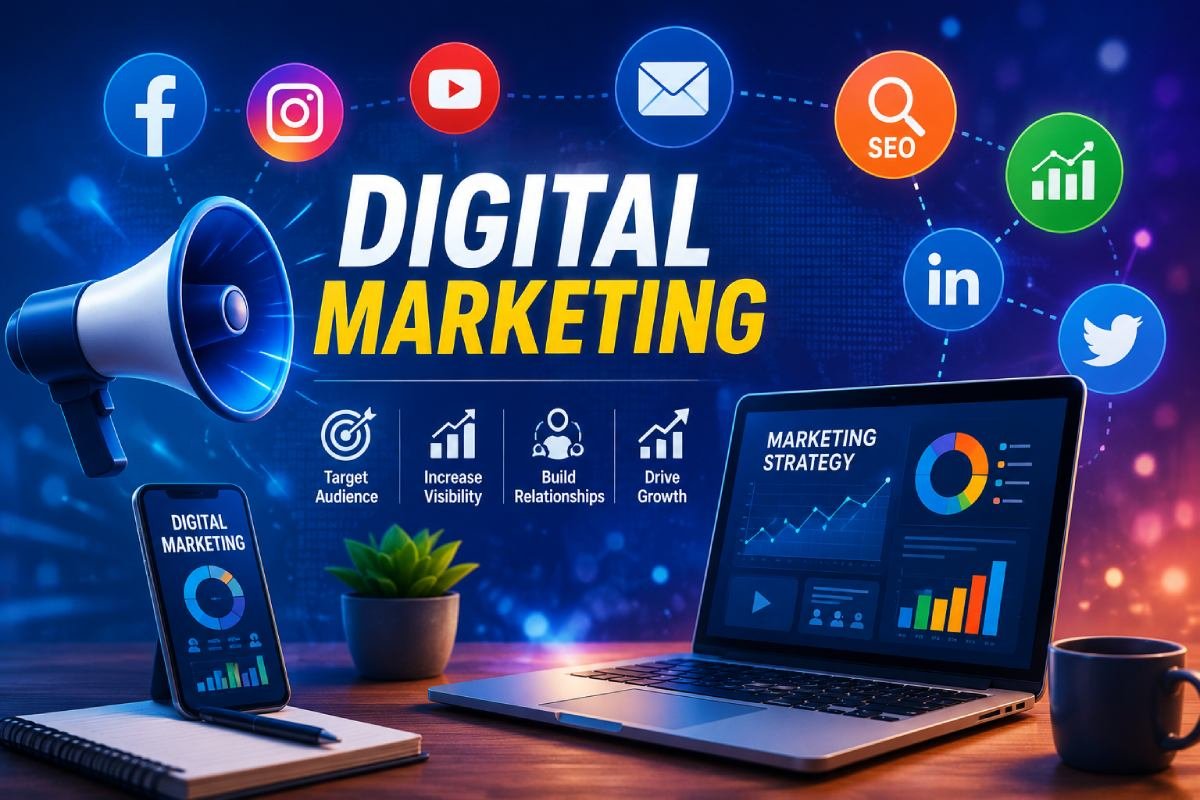
Digital marketing has become one of the most important ways for businesses to reach customers, build brand awareness, generate leads, and increase sales. As consumers increasingly use search engines, social media, websites, email, and online platforms to discover products and services, businesses need a strong digital presence to remain competitive.
Whether you are running a small local business, an e-commerce store, a startup, or an established company, digital marketing provides multiple ways to connect with the right audience. The key is understanding how different digital marketing channels work together and creating a strategy that matches your business goals.
What Is Digital Marketing?
Digital marketing refers to promoting products, services, brands, or businesses through digital channels. These channels can include search engines, websites, social media platforms, email, online advertising, content platforms, and other internet-based communication channels.
Unlike traditional marketing, digital marketing allows businesses to communicate with specific audiences and measure many aspects of their campaigns. Companies can analyze website traffic, engagement, leads, conversions, advertising performance, and customer behavior to make better marketing decisions.
Digital marketing is therefore not simply about posting on social media or running advertisements. It is a complete ecosystem involving strategy, content, technology, data, creativity, and customer experience.
Why Digital Marketing Is Important for Businesses
A strong online presence can help businesses reach customers beyond their physical location. Even a small company can attract potential customers from different cities, regions, or countries when its digital strategy is properly planned.
Digital marketing also allows businesses to communicate with customers throughout the buying journey. Someone may first discover a brand through a search engine, later see its social media content, visit the website, read a blog post, and eventually become a customer.
This ability to remain visible across multiple touchpoints makes digital marketing an important part of modern business growth.
Search Engine Optimization
Search Engine Optimization, commonly known as SEO, focuses on improving a website’s visibility in search engine results.
SEO involves several areas, including website structure, technical performance, content quality, keyword targeting, internal linking, user experience, and authority-building activities.
A successful SEO strategy does not focus only on inserting keywords into articles. Search engines increasingly evaluate whether content is useful, relevant, trustworthy, and capable of satisfying the user’s search intent.
Businesses that consistently publish valuable content and maintain a technically sound website can build sustainable organic visibility over time.
Content Marketing
Content marketing focuses on creating useful and relevant information for a specific audience. Blog posts, guides, videos, infographics, case studies, podcasts, social posts, and other formats can all become part of a content strategy.
Good content answers questions, solves problems, explains products, demonstrates expertise, and helps potential customers make informed decisions.
For example, a website selling skincare products could publish educational content about skincare routines, ingredient selection, seasonal skincare, and common skincare mistakes. This type of content can attract people before they are ready to purchase.
Social Media Marketing
Social media provides businesses with a way to communicate directly with their audiences. Platforms can be used to build awareness, share content, introduce products, answer questions, and create communities.
The most effective social media strategy is not necessarily the one that publishes the highest number of posts. Instead, businesses should focus on creating content that matches the interests and behavior of their target audience.
Educational posts, short videos, behind-the-scenes content, customer stories, product demonstrations, and interactive content can all contribute to stronger engagement.
Pay-Per-Click Advertising
Pay-Per-Click, or PPC, advertising allows businesses to display paid advertisements across search engines and other digital platforms.
Unlike organic SEO, which can take time to build, paid advertising can provide immediate visibility when campaigns are properly configured.
However, successful PPC marketing requires careful keyword selection, audience targeting, compelling advertisements, effective landing pages, budget management, and continuous performance analysis.
Simply increasing an advertising budget does not guarantee better results. The quality and relevance of the entire customer journey matter.
Email Marketing
Email marketing remains a valuable channel for maintaining relationships with customers and prospects.
Businesses can use email to share educational content, product announcements, special offers, newsletters, company updates, and personalized recommendations.
A strong email strategy focuses on providing value rather than sending excessive promotional messages. Segmenting audiences based on interests or customer behavior can also make communication more relevant.
Website Design and User Experience
A business website is often the central destination for digital marketing campaigns. Even a successful advertisement or social media post can fail to generate results if visitors encounter a slow, confusing, or difficult-to-use website.
A good website should clearly communicate what the business offers and make it easy for visitors to find important information.
Mobile responsiveness, page speed, intuitive navigation, readable content, strong calls to action, trust signals, and simple forms can all contribute to a better user experience.
Online Reputation Management
Customers often research businesses before making a purchase. Reviews, ratings, social media discussions, and online mentions can influence how people perceive a brand.
Online Reputation Management focuses on monitoring and improving a company’s digital reputation. Businesses can encourage genuine customer feedback, respond professionally to reviews, address complaints, and maintain accurate information across online platforms.
A strong reputation can increase trust, while poor communication can damage customer confidence.
Influencer Marketing
Influencer marketing involves collaborating with individuals who have an established audience and influence within a particular niche.
The right influencer can introduce a product or service to a relevant audience in a more personal way than traditional advertising.
However, follower count should not be the only consideration. Audience relevance, engagement quality, credibility, content style, and brand alignment can be more important when choosing a creator.
Local Digital Marketing
Local businesses can use digital marketing to attract customers within specific geographic areas. Local SEO, business listings, customer reviews, location-focused content, social media, and paid advertising can all support local visibility.
For example, a restaurant, dental clinic, salon, hotel, electrician, or real estate company can create content and optimize its online presence around the locations it serves.
Accurate business information is especially important for local customers who need directions, contact details, opening hours, or immediate service information.
E-Commerce Digital Marketing
Online stores require a digital marketing strategy that covers the entire customer journey. Customers need to discover products, understand their benefits, trust the business, and complete purchases easily.
E-commerce marketing can involve SEO, product-page optimization, social media, paid advertising, email marketing, remarketing, content marketing, and customer retention campaigns.
Product images, descriptions, reviews, pricing information, shipping details, and a smooth checkout experience can all influence conversion rates.
The Role of Data and Analytics
One of the biggest advantages of digital marketing is the ability to measure performance.
Businesses can analyze traffic sources, user engagement, lead generation, conversion rates, advertising costs, customer behavior, and other important metrics.
Data should not simply be collected. It should be used to answer practical questions such as which channels generate valuable customers, which content performs well, where users leave the website, and which campaigns produce the strongest return.
This allows businesses to improve their strategies based on evidence rather than assumptions.
Digital Marketing and Brand Building
Digital marketing is not only about generating immediate sales. It also plays an important role in building a recognizable brand.
Consistent visual identity, messaging, tone, content quality, customer communication, and online experiences can help people remember a business.
A strong brand can create familiarity and trust, which may influence future purchasing decisions even when customers are not ready to buy immediately.
Personalization in Digital Marketing
Customers increasingly expect relevant communication. Personalization allows businesses to deliver content, recommendations, advertisements, or messages based on customer interests and behavior.
For example, an online store can recommend products related to previous purchases, while an email campaign can send different messages to new subscribers and returning customers.
Personalization should be useful rather than intrusive. Customers should feel that communication is relevant, not that their privacy is being unnecessarily compromised.
The Importance of Video Marketing
Video has become an important format across digital platforms. Businesses can use videos to explain products, demonstrate services, answer questions, tell stories, share customer experiences, and communicate their brand personality.
Short-form videos can help attract attention, while longer educational videos can provide deeper information.
The best video strategy depends on the target audience and the purpose of the content rather than simply following every platform trend.
Building a Strong Digital Marketing Strategy
A successful digital marketing strategy begins with clear objectives. A business should know whether it wants to increase brand awareness, generate leads, increase online sales, improve customer retention, or achieve another measurable outcome.
The next step is understanding the target audience and identifying where those customers spend time online.
Once the audience and objectives are clear, businesses can select appropriate channels, create content, establish campaigns, measure results, and continuously improve their approach.
Common Digital Marketing Mistakes
One common mistake is trying to use every marketing channel at the same time. A business may achieve better results by focusing on a few channels that align with its audience and goals.
Another mistake is prioritizing quantity over quality. Publishing large amounts of weak content or running advertisements without proper targeting can waste resources.
Ignoring analytics, neglecting mobile users, failing to update website content, and not responding to customers can also reduce the effectiveness of a digital marketing strategy.
How Businesses Can Improve Digital Marketing Results
Improvement usually comes from consistent testing and optimization. Businesses can experiment with different content formats, advertising messages, landing pages, calls to action, audiences, and publishing strategies.
Performance should then be reviewed using meaningful metrics.
Digital marketing is rarely a one-time activity. Consumer behavior, competition, technology, and platforms continue to change, so businesses need to learn and adapt continuously.
The Future of Digital Marketing
Digital marketing will continue evolving as technology changes the way people search, communicate, shop, and consume information.
Automation, artificial intelligence, data analysis, personalization, video content, conversational experiences, and new digital platforms are likely to influence how businesses interact with customers.
However, technology alone cannot replace the fundamentals of good marketing. Understanding customers, creating useful experiences, communicating clearly, and building trust will remain important regardless of which tools become popular.
Frequently Asked Questions
What is digital marketing in simple words?
Digital marketing is the process of promoting a business, product, service, or brand through online channels such as search engines, websites, social media, email, and digital advertising.
What are the main types of digital marketing?
Major areas include SEO, content marketing, social media marketing, PPC advertising, email marketing, influencer marketing, online reputation management, affiliate marketing, and e-commerce marketing.
Is digital marketing useful for small businesses?
Yes. Small businesses can use digital marketing to reach local or specialized audiences, build brand awareness, generate leads, and compete with larger businesses.
Which is better, SEO or PPC?
Neither is universally better. SEO can provide long-term organic visibility, while PPC can generate paid visibility more quickly. Many businesses benefit from using both strategically.
How long does digital marketing take to produce results?
The timeframe depends on the channel, competition, industry, budget, website quality, and strategy. Paid campaigns can generate results quickly, while SEO and content marketing often require longer-term consistency.
Why is content important in digital marketing?
Content helps businesses educate audiences, answer questions, demonstrate expertise, attract search traffic, support social media activity, and guide potential customers through the buying journey.
Can digital marketing increase sales?
Yes, when properly planned and executed. Digital marketing can attract relevant audiences, build trust, generate leads, support conversions, and encourage repeat purchases.
Conclusion
Digital marketing has transformed the way businesses communicate with customers. From SEO and content marketing to social media, PPC, email, video, and analytics, businesses now have numerous opportunities to build visibility and create meaningful customer relationships.
The most successful approach is not simply using more platforms. It is developing a clear strategy based on business objectives, audience needs, useful content, strong customer experiences, and measurable results.
Digital marketing works best as an ongoing process of learning, testing, analyzing, and improving. Businesses that consistently adapt while keeping customer needs at the center of their strategy can build stronger digital visibility and create sustainable opportunities for growth.