
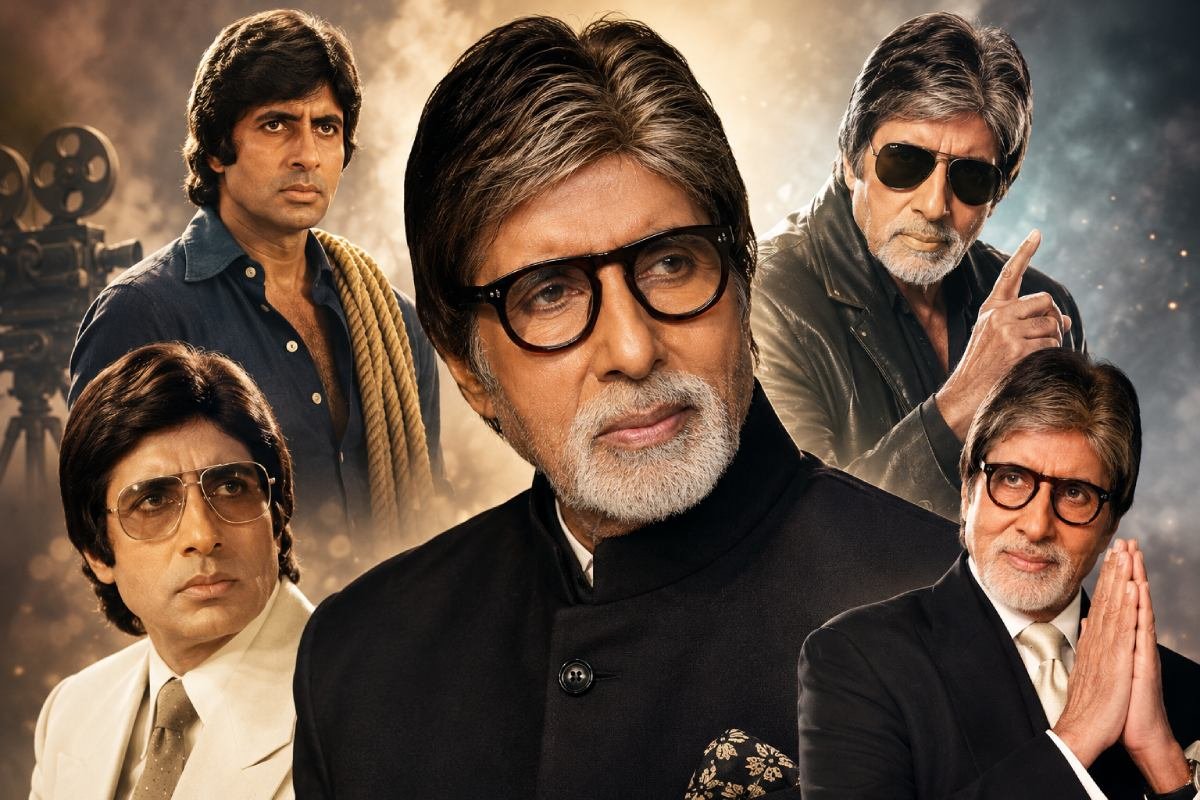
Amitabh Bachchan is one of the most influential and respected figures in Indian cinema. With a career spanning more than five decades, he has worked as an actor, television host, producer, playback singer, and occasional narrator. His powerful voice, distinctive screen presence, memorable performances, and ability to adapt to changing generations have made him a lasting icon of Hindi cinema.
From his early struggles in the film industry to becoming known as the “Shahenshah of Bollywood” and the “Big B,” Amitabh Bachchan’s journey represents one of the most remarkable careers in Indian entertainment.
Early Life and Family Background
Amitabh Bachchan was born on October 11, 1942, in Allahabad, which is now known as Prayagraj, Uttar Pradesh, India. He was born into a family with strong literary connections. His father, Harivansh Rai Bachchan, was one of India’s celebrated Hindi poets, while his mother, Teji Bachchan, was known for her involvement in social and cultural activities.
Growing up in a literary environment exposed Amitabh to language, poetry, culture, and performance from an early age. His father’s reputation as a poet also influenced Amitabh’s appreciation of literature and his exceptional command of language.
Before entering the film industry, Amitabh completed his education and worked briefly in Kolkata. His deep voice, which later became one of his most recognizable characteristics, initially created difficulties when he attempted to enter the world of film.
Beginning of His Film Career
Amitabh Bachchan made his film debut in Saat Hindustani, released in 1969. The film gave him an opportunity to enter Hindi cinema, but his early years were not immediately successful.
He appeared in several films during the early part of his career, often playing supporting or secondary characters. Although he possessed a distinctive appearance and voice, establishing himself as a leading actor took time.
His persistence eventually paid off when filmmakers began recognizing his ability to portray intense and serious characters.
The Rise of the Angry Young Man
The defining transformation in Amitabh Bachchan’s career came during the 1970s. At a time when Hindi cinema frequently featured romantic heroes, Amitabh brought a different kind of energy to the screen.
His roles often represented frustrated young men dealing with injustice, corruption, poverty, and social inequality. This image became popularly associated with the phrase “angry young man.”
Films such as Zanjeer, Deewaar, and Sholay played a major role in establishing this image. His powerful dialogue delivery, intense expressions, physical presence, and ability to portray emotionally complicated characters connected strongly with audiences.
The character of Vijay, which appeared in several of his major films, became particularly associated with his screen persona.
The Success of Zanjeer
Zanjeer, released in 1973, was a major turning point. Amitabh played Inspector Vijay Khanna, a serious police officer determined to fight crime and corruption.
The film presented a different kind of hero from the romantic stars who had dominated Hindi cinema. Amitabh’s performance helped establish him as a major leading actor.
The success of Zanjeer opened the door to a series of important roles and changed the direction of his career.
Sholay and Becoming a Superstar
One of Amitabh Bachchan’s most iconic films is Sholay, released in 1975. Directed by Ramesh Sippy, the film featured Amitabh as Jai alongside Dharmendra as Veeru.
The film became a landmark in Indian cinema, combining action, drama, comedy, romance, and memorable characters. Amitabh’s quiet and restrained portrayal of Jai contrasted with the more expressive Veeru, creating one of Hindi cinema’s most memorable partnerships.
Sholay helped establish Amitabh as one of India’s biggest movie stars and became an important part of his legacy.
Deewaar and Powerful Characters
Deewaar, also released in 1975, further strengthened Amitabh Bachchan’s reputation as an actor capable of portraying morally complicated characters.
His portrayal of Vijay Verma explored themes of family, poverty, ambition, crime, and personal morality. The film became known for its powerful writing and dialogue, while Amitabh’s performance received considerable recognition.
Together, Zanjeer, Deewaar, and Sholay helped define the image of Amitabh Bachchan as a powerful dramatic and action star.
Versatility Beyond Action Films
Although Amitabh became famous for serious and action-oriented roles, his career was never limited to one genre. He demonstrated considerable versatility through romantic films, family dramas, comedies, social stories, and emotional roles.
Movies such as Kabhie Kabhie, Amar Akbar Anthony, Don, Muqaddar Ka Sikandar, Namak Halaal, and Silsila demonstrated different aspects of his acting ability.
His performance in Amar Akbar Anthony particularly highlighted his comic timing. The film allowed him to move away from the serious “angry young man” image and demonstrate his ability to entertain audiences through humor and physical comedy.
Amitabh Bachchan in Don
Don, released in 1978, became another important film in Amitabh’s career. He played both the sophisticated criminal Don and the innocent village man Vijay.
The dual role allowed him to demonstrate contrasting personalities within the same film. Don’s style, confidence, dialogue delivery, and screen presence became iconic.
The film later inspired a new generation of filmmakers to revisit the character, although Amitabh’s original portrayal remains one of the most remembered performances of his career.
The 1980s and His Political Career
During the 1980s, Amitabh Bachchan remained one of India’s biggest stars. However, his career temporarily moved beyond cinema when he entered politics.
He contested and won a seat in the Indian Parliament in 1984 as a member of the Lok Sabha. His political career was relatively brief, and he eventually resigned from Parliament.
After returning to cinema, he continued working in films while dealing with the changing landscape of the Hindi film industry.
The Life-Threatening Injury
One of the most dramatic events in Amitabh Bachchan’s life occurred during the filming of Coolie in 1982.
He suffered a serious abdominal injury while filming an action sequence. The incident resulted in a prolonged period of hospitalization and became a major national concern, with fans across India following reports about his recovery.
Amitabh eventually recovered and returned to work. The incident became an important part of his personal story and demonstrated the enormous public affection surrounding him.
Career Challenges in the 1990s
The 1990s were considerably more difficult for Amitabh Bachchan professionally. Several of his films did not perform as expected, and his popularity as a leading actor was not as strong as it had been during the previous decades.
He also established a production company and became involved in the business side of filmmaking. However, the venture experienced financial difficulties.
This period demonstrated that even one of India’s biggest stars could experience major professional setbacks.
The Television Comeback
A remarkable second phase of Amitabh Bachchan’s career began with television.
In 2000, he became the host of the Indian version of Who Wants to Be a Millionaire?, known as Kaun Banega Crorepati or KBC.
The program became hugely popular, and Amitabh’s hosting style played an important role in its success. His warm conversations with contestants, powerful voice, humor, and ability to connect with ordinary people made the show a major television phenomenon.
KBC helped introduce Amitabh to a younger generation and significantly strengthened his public presence.
The Comeback to Mainstream Cinema
Following his television success, Amitabh Bachchan experienced a major resurgence in film. Instead of competing for the same young leading-hero roles he had played decades earlier, he embraced mature and character-driven performances.
Films such as Mohabbatein, Kabhi Khushi Kabhie Gham, Baghban, Black, Sarkar, Paa, and Cheeni Kum demonstrated the range of roles he could play as an older actor.
His ability to reinvent himself allowed him to remain relevant while the Hindi film industry continued changing.
Black and Critical Recognition
Black, directed by Sanjay Leela Bhansali, became one of Amitabh Bachchan’s most acclaimed performances.
He played Debraj Sahai, a teacher who helps a young woman with disabilities communicate and learn. The role was emotionally demanding and required a very different performance from the action heroes of his earlier career.
The film received widespread critical appreciation, and Amitabh’s performance reinforced his reputation as an actor capable of taking on complex and challenging characters.
Paa and Character Transformation
In Paa, Amitabh took on another unusual role by portraying a child suffering from a rare genetic condition.
The character required extensive makeup and physical transformation. His performance demonstrated his willingness to experiment with roles even after achieving legendary status.
Rather than relying solely on his established image, Amitabh continued accepting characters that required him to transform his appearance and performance style.
Amitabh Bachchan as a Voice Artist
Amitabh’s deep and distinctive voice has become almost as famous as his acting. His voice has been used for film narration, documentaries, advertisements, television programs, and other projects.
His narration has appeared in films such as Lagaan, where his voice contributed to the storytelling atmosphere.
His ability to deliver dialogue with authority and emotion has made his voice a recognizable part of Indian popular culture.
Family Life
Amitabh Bachchan is married to actress Jaya Bachchan. The couple has two children, Abhishek Bachchan and Shweta Bachchan.
Abhishek Bachchan followed his father into acting and has appeared in numerous Hindi films. Shweta Bachchan has pursued interests outside mainstream acting and has been involved in writing, fashion, and other creative activities.
Amitabh’s family has remained a prominent part of Indian entertainment culture, particularly because both Amitabh and Jaya have had long careers in cinema.
Amitabh Bachchan as a Producer
Amitabh Bachchan has also been involved in film production. His experience with his own production company gave him an opportunity to explore the business side of the entertainment industry.
Although production brought financial challenges during one period of his career, it also demonstrated his willingness to take risks beyond acting.
His career has therefore extended across multiple areas of entertainment rather than being limited to acting alone.
Awards and Achievements
Amitabh Bachchan has received numerous prestigious awards throughout his career. He has won multiple National Film Awards for his performances and has received several Filmfare Awards.
He has also been honored with some of India’s highest civilian awards, including the Padma Shri, Padma Bhushan, Padma Vibhushan, and Bharat Ratna-level recognition through various national and international honors. He was awarded the Dadasaheb Phalke Award, India’s highest film honor, in recognition of his contribution to Indian cinema.
His awards reflect both his commercial success and his critical reputation as one of India’s most accomplished performers.
Amitabh Bachchan and Indian Popular Culture
Few Indian actors have had an influence on popular culture comparable to Amitabh Bachchan.
His dialogue delivery, hairstyles, clothing, mannerisms, songs, and characters have been imitated by generations of fans. His screen name and image have become part of everyday references in Indian entertainment.
The phrase “Big B” became widely associated with him, while his famous baritone voice and dramatic style became instantly recognizable.
His influence can also be seen in the way later generations of actors approach action, dialogue delivery, and mature character roles.
His Digital Presence and Connection With Fans
Amitabh Bachchan has also embraced digital communication and social media. He has maintained a strong online presence, regularly sharing thoughts, photographs, memories, and updates with fans.
This has allowed him to maintain a direct relationship with audiences even as the entertainment industry has moved from traditional media toward digital platforms.
His willingness to communicate with fans online has helped keep his public image relevant across generations.
Why Amitabh Bachchan Remains an Icon
Amitabh Bachchan’s longevity is one of the most remarkable aspects of his career. Many actors become associated with a particular generation, but Amitabh has successfully remained visible through multiple eras of Indian cinema.
He moved from romantic and action roles to character-driven performances, from cinema to television, and from traditional media to digital platforms.
His ability to adapt without losing his distinctive identity has been a major factor in his continued popularity.
Legacy of Amitabh Bachchan
Amitabh Bachchan’s legacy extends far beyond his filmography. He helped redefine the image of the Hindi-film hero during the 1970s and later demonstrated how an established superstar could reinvent himself through television and character roles.
His career includes extraordinary successes, difficult periods, health challenges, business setbacks, political involvement, and remarkable comebacks.
For generations of Indian audiences, Amitabh Bachchan represents more than a film star. He represents dedication, reinvention, professionalism, and the lasting power of cinema.
Frequently Asked Questions About Amitabh Bachchan
When was Amitabh Bachchan born?
Amitabh Bachchan was born on October 11, 1942, in Allahabad, Uttar Pradesh, India.
What was Amitabh Bachchan’s first film?
Amitabh Bachchan made his film debut in Saat Hindustani, which was released in 1969.
Which film made Amitabh Bachchan a major star?
Zanjeer, released in 1973, is widely regarded as one of the major films responsible for establishing Amitabh Bachchan as a leading star.
Why is Amitabh Bachchan called the Angry Young Man?
During the 1970s, Amitabh frequently portrayed frustrated and rebellious characters dealing with social injustice, corruption, poverty, and personal struggles. This led to his popular “angry young man” image.
What is Amitabh Bachchan famous for besides acting?
He is also famous for hosting Kaun Banega Crorepati, his distinctive voice, film production, television work, narration, and his long-standing contribution to Indian entertainment.
Who is Amitabh Bachchan’s wife?
Amitabh Bachchan is married to actress and politician Jaya Bachchan.
Who are Amitabh Bachchan’s children?
Amitabh Bachchan and Jaya Bachchan have two children: actor Abhishek Bachchan and author and entrepreneur Shweta Bachchan Nanda.
What is Kaun Banega Crorepati?
Kaun Banega Crorepati, commonly known as KBC, is the Indian adaptation of the international quiz-show format Who Wants to Be a Millionaire? Amitabh Bachchan became strongly associated with the program as its host.
What are some of Amitabh Bachchan’s most famous movies?
Some of his most recognized films include Zanjeer, Deewaar, Sholay, Don, Amar Akbar Anthony, Muqaddar Ka Sikandar, Agneepath, Black, Paa, Sarkar, and Mohabbatein.
Why is Amitabh Bachchan considered a Bollywood legend?
His extraordinary longevity, memorable performances, distinctive voice, versatility, major box-office successes, television career, awards, and influence on Indian popular culture have established him as one of the most important figures in Hindi cinema.
Conclusion
Amitabh Bachchan’s biography is a story of ambition, struggle, success, reinvention, and extraordinary longevity. From his early days as a struggling actor to his rise as the defining “angry young man” of the 1970s, he became one of India’s biggest stars and eventually transformed himself into a respected character actor and television personality.
His journey demonstrates that a successful career is not simply about reaching the top but also about adapting when circumstances change. Through cinema, television, production, narration, and digital communication, Amitabh Bachchan has continued to connect with audiences across generations.
After decades in the entertainment industry, his name remains synonymous with Indian cinema, and his body of work continues to influence actors, filmmakers, and audiences around the world.